J.R. Hay
I apologize to my devotees for the lack of posts during the previous month, it was a time of a great many decisions one of which was accepting a Ph.D. offer from UNC Charlotte. Finally being free from the grips of the consternation of planning my post-undergraduate life (for now) I am pleased to bring you a new post on the sublime of luck and its application to March Madness.
It is early April and the madness of March is still bleeding its way through our calendar. A week from the finale in which Iowa and South Carolina (women’s) and UConn and Purdue (men’s) will battle for ultimate collegiate supremacy. Like most years I make a bracket, not because I particularly enjoy college basketball but because I enjoy the thrills of probability. You may think this is a bit nerdy but I assure you it is within human nature to crave statistical chance. This is self-evident in the rise of online sports betting which has spread expeditiously throughout the nation and the world. March Madness is the pinnacle of such societal obsession. 64 teams play in a single-round elimination bracket consolidating week after week to 32, 16, 8, 4, 2, and finally 1. Such a series of events can be expressed mathematically as a conditional probability tree wherein each new set of games is dependent upon the results of the previous set of games. In this respect to win March Madness you must correctly predict 63 games (n-1; n being the number of teams in the tournament). If you do so you will be the recipient of major news attention and an official one-million dollar prize.
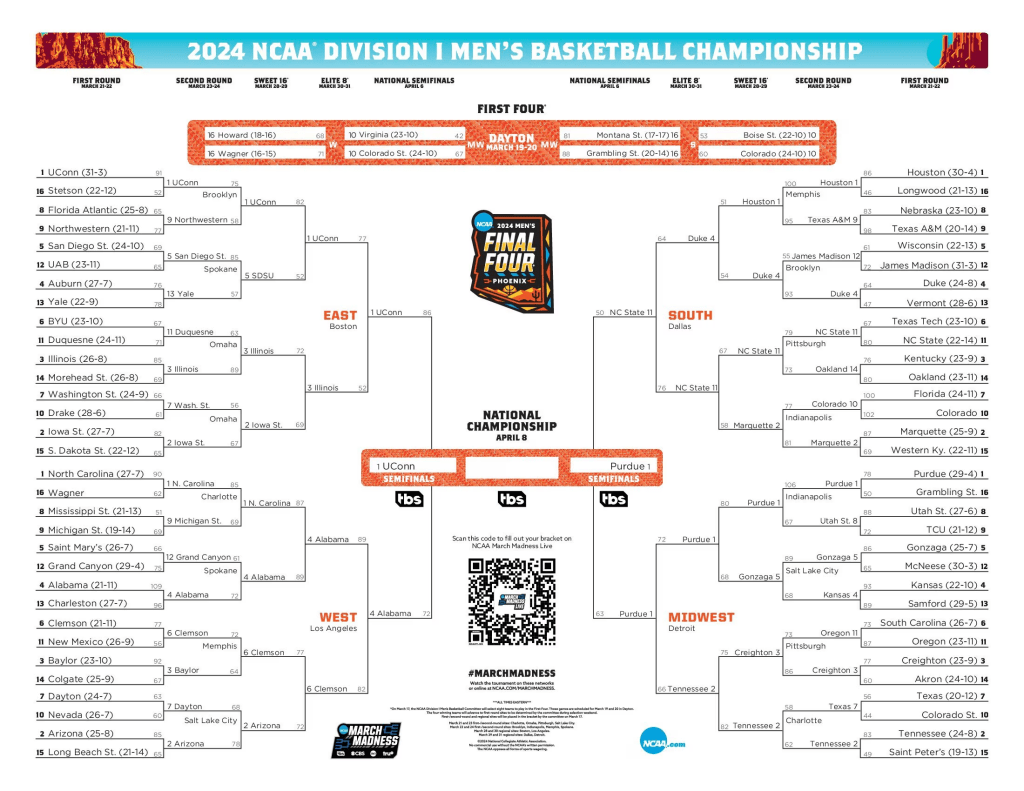
Calculating conditional probability trees is a tad more involved and thankfully is unnecessary for this problem. This is because March Madness is a very special case of problem it is all or nothing. In this way, we can ignore the conditionality of teams needing to move on to be in the next game, if one team loses our bracket is a bust. Every game can be treated independently because we need to predict 63 games correctly in a row, if we wanted instead to know the probabilities of creating a bracket with 90% correct choices or any other percent then it would be a longer problem. (Perhaps next year I can undertake this in a part two of this post.
| Chance of Correctly Choosing Winner in any game (%) | Odds of Creating a Perfect Bracket |
| 50% | 1 out of 9.2233720369×10^18 |
| 55% | 1 out of 2.2758863017×10^16 |
| 60% | 1 out of 9.4726442145×10^13 |
| 65% | 1 out of 6.115874029×10^11 |
| 70% | 1 out of 5.7388315747×10^9 |
| 75% | 1 out of 74,325,939.2966 |
| 80% | 1 out of 1,274,473.52891 |
| 90% | 1 out of 763.346828089 |
| 99% | 1 out of 1.88357423137 |
For independent events, we can calculate our success rate by our probability of choosing correctly raised to the number of games. If we choose let’s say one half then we will get odds of 1 out of 9 quintillion, this stat is echoed by every article referring to March Madness but in all honesty, it is a bit misleading. We as humans are better than a random flip on average and going by popular opinion one could conceivably reach a percentage. I do not have the authority to tell you how well we can guess but the following table will show you your success rate by per game probabilities. I will note that there is an old adage about the probability of picking a specific grain of sand out of all the sand in the world being less than making a perfect bracket, this is wrong as the estimation of sand grains in the world has been increased several times and is now several orders of magnitude higher. Instead, I would say that for something on a similar order of magnitude if your odds were about .55 in favor of picking the right team then it would be a similar chance of picking a correct ant out of all the ants in the world.
Seeing the tournament in this light and understanding that most experts can’t crack 70% in terms of guessing winners in any given game the one million prize begins to look more pitiful. I propose an adjusted lottery, comparing odds to the largest American lottery system, Powerball. The largest Powerball jackpot accrued in the fall of 2022 sitting at 2.04 Billion Dollars. According to AP News lottery officials set the odds at 1 out of 292.2 million. So we must simply divide our march madness odds, let’s go with a skilled 65% success rate to not let it soar too high. The odds of a perfect bracket then are 2093 times higher than the odds of winning Powerball. This means that our new adjusted jackpot prize for successfully creating the perfect bracket is 4.27 trillion dollars or 4.2698093837×10^12. This prize pool eclipses the GDP of all but two nations, the United States and China and, roughly 4 percent of the Global GDP.
You may be thinking this is a steep price to pay but it is only a scaled-up version of Powerball a successful institution. Perhaps one day a small country will realize the money making potential of charging for brackets and place a much more adjusted bet to fuel their economy. Until then, one will have to be content with the plethora of fame, book deals, and interviews that would surely come with such a feat.
 The Sun Bear Journal
Leave a comment