JR Hay
As an undergraduate no class vexed me more than Quantum Mechanics and my experience is definitely not unique. Richard Feynman once said “I think I can safely say that nobody understands quantum mechanics.” Well in that case the most we can do is to try.
Without going into a course-long explanation of the theory, Quantum Mechanics can be described pretty aptly by a single particle. To make our problem simpler let’s say the particle is constrained to one spatial dimension. To describe our particle we need the Schrödinger Wave Equation, this equation is the backbone of quantum mechanics. Let us also say that the equation has no time independence, this is valid for the long case until the collapse of measurement which we will soon discuss.

This form of the equation which relates kinetic energy (the left term) and potential energy (V) to the total Energy(E) operating on the wave function is very similar to the Lagrange equation, widely known you have any experience in classical mechanics. The solution to this second order homogenous differential equation is a set of Energies, these energies operate on the wave function (psi) and result in different functions. All of these functions are valid solutions and thus can exist physically. In the case of a single particle limited to one dimension of freedom this results in harmonics.
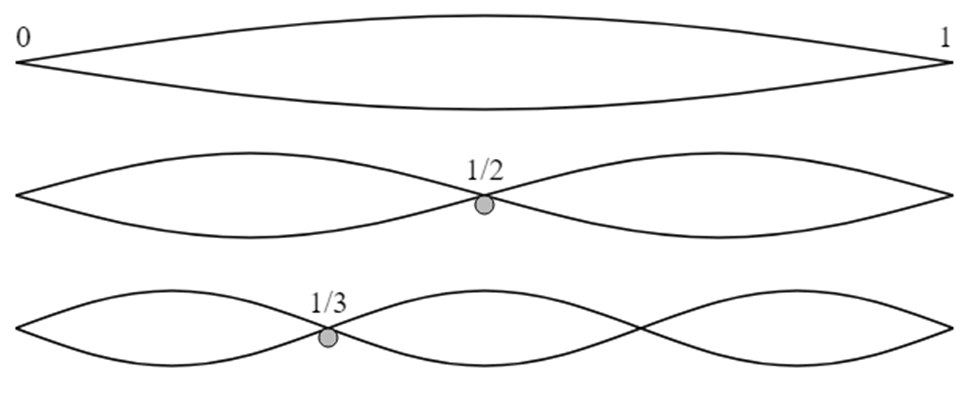
Now that we have a valid wave function (one of the solutions) we can square it to determine the probability distribution function of our particle. Once we make a measurement we consider this wave function and in the same thinking the probability distribution function to collapse onto a single location. This is very intuitive for most, the particle must be somewhere when we measure it and immediately after we measure it we must know where it is.
What’s the big deal then !? Quantum mechanics seems to work like any other classical system… we just don’t know much about the mechanism behind it. Well this is where it gets interesting, by making a measurement we are in fact affecting the particle. This means that with any measurement we can not know fully both the position and the momentum (or the movement) at any given time with complete certainty. Heisenberg’s Uncertainty Principle formalizes this relationship in terms of Plank’s Constant adjusted to H-bar in terms of Joule*seconds a unit of angular momentum. This doesn’t matter on the large scale since h-bar is astronomically tiny 1.054571817×10⁻³⁴ J*s.

Without delving any further we can see that at the small scale quantum mechanics predicts particles to act probabilistically, leading to effects of tunneling, entanglement, and wavelike properties. This understanding of Quantum Mechanics is shallow and I implore you to delve deeper (if you do wish to see the resources listed at the end of the page.) but it will suffice to explore some of the interesting interpretations that physicists have come up with over the years.
Copenhagen Interpretation Niels Bohr, Werner Heisenberg
The Copenhagen Interpretation separates the quantum state from any real physical system. The quantum state then merely serves to inform what we can expect when taking measurements of the system. Since the wavefunctions intensity gives us experimentally verifiable probabilities it is descriptive of our perception of the system. The proponents of Copenhagen’s interpretation draw a line between descriptive of our perspective and descriptive of the underlying physical interactions. Such physical interactions are possibly impossible to know especially when making assumptions on what we already know from experiment. The largest issue with this theory is the definite rift between classical and quantum phenomena. If the Copenhagen Interpretation is to be true then there must be some line which separates the micro from the macro, something which we don’t observe.
Einstein Interpretation Albert Einstein
Einstein’s interpretation branches off of the Copenhagen interpretation and I include it only to payhomagee to its most popular devotee. Einstein considered the wave function to be a tool like Copenhagen but unlike Copenhagen Einstein believed that there was an underlying mechanism which could be determined through the methods of physics. This notion was undermined by later proof, and then reinstated by breaking several physical conventions in the Pilot Wave Theory.
Pilot Wave Theory Louis de Broglie, David Bohm
John Bell circa 1964 proposed a theorem meant to prove that quantum mechanics was an incomplete theory involving variables yet undiscovered. Bell proved instead that there could be no hidden variables to explain the probabilistic nature of quantum mechanics using electron spin as the focus. This would seem to destroy any would be theories which propose such hidden dynamics at play. The Pilot Wave theory does not however play by the same rules as Bell’s theorem. Bell assumed two things; locality which means that information does not travel faster than the speed of light between particles and independence which means that the properties of separate particles are independent. Bohm theorized that particles operate in a non-localized fashion, in other words particles have instantaneous information about the other particles which surround them.
Bohm theorized that particles are guided by a field known as the pilot field which holds a dependence on the particles that they guide. In this sense, Bohm predicts that the particle is always in one place as opposed to other interpretations where the probability of the wave function is taken to mean physically until measurement.
Many Worlds Interpretation Hugh Everett
Hugh Everett came relatively late to the party, first proposing his Many Worlds Interpretation in 1957. In this Interpretation when a measurement is made the wave function does not collapse, instead the particle is located at every possible location in different realities. These possibilities are mutually exclusive (if one happens another is equally likely to occur) and so the universes which they do decouple from each other in a process called decoherence. (Coherence suggesting consistency) This means that every physical possibility will occur and thus if true many worlds could be better dubbed unfathomable infinite worlds. The butterfly effect has nothing on the many worlds interpretation.
Objective Collapse
Giancarlo Ghirardi, Alberto Rimini, Tullio Weber, Roger Penrose
In objective collapse theories (there are a few) let us stop beating around the bush of the wavefunction being a pure descriptor devoid of physical meaning. The problem with wave function collapse is that it is non-reversable, non local, and occurs instantaneously. The problem is that the Schrödinger equation obeys these rules, it is linear. In order to interweave these two contradictions a nonlinear term was added to the Schrödinger equation. This term defines when wave collapse may occur giving a small probability for any single quantum particle to exhibit collapse but upon collapse all particles within the system also collapse. This addition means that wave collapse only occurs when multiple particles are involved in a system because otherwise the probability is far too low.
Conclusion
All of these theories have their strengths and weaknesses and some physicists believe that we will probably never understand the full picture due to measurement restrictions. My favorite theory is the Shut up and Calculate theory which proposes that it doesn’t matter as long as experiment keeps matching up, and matching up it does. Quantum Mechanics is a beautifully successful theory of Physics which describes the sub atomic realm extremely well. Please let me know if I missed any fun theories or some which you personally prescribe too.
Resources
David Griffiths Introduction to Quantum Mechanics Third Edition
Some Light Quantum Mechanics Minute 3Blue1Brown & Minute Physics
Sources
1 P.J. Lewis, “Quantum Mechanics, Interpretations of | Internet Encyclopedia of Philosophy,” (n.d.).
2 D. Bohm, “A Suggested Interpretation of the Quantum Theory in Terms of ‘Hidden’ Variables. I,” Physical Review 85(2), 166–179 (1952).
3 S. Hossenfelder , “David Bohm’s Pilot Wave Interpretation of Quantum Mechanics,” Www.youtube.com, (n.d.).
4“Is The Wave Function The Building Block of Reality?,” Www.youtube.com, (n.d.).


 The Sun Bear Journal
Leave a reply to SelfAwarePatterns Cancel reply